Article 2

Article 2

On Wednesday October 16th we hosted our biannual Solution Series — Organizational Structure: A Tool to Advance Innovation and Business Bottom Line—at Mutual of American in Manhattan.

A packed house of new and longtime supporters and friends of The Fedcap Group heard a dynamic panel of experts lead a compelling discussion about organizational structure. Hundreds more participated via livestream! The panel included – Michael Sicard, Chairman and CEO, USI Insurance Services Dianne Morales, Executive Director and CEO, Phipps Neighborhoods Mario Desideiro, Enterprise Solutions and Analytics Practice Leader, Managing Director, Huron Consulting Group Takeaways from the discussion were that structure should be designed to unlock teamwork and creativity; that structure must enable employees to always challenge themselves and have a vested interest in outcomes, and that structure must be flexible enough to allow for the ongoing infusion of new talent. The panel emphasized how strategy drives structure, that the design and building of structure must be intentional, and that while no single structure works for every organization, transparency and cross-functional teamwork are often hallmarks of successful structure.

Thanks to Mutual of America for hosting this event. Stay tuned for information about our spring Solution Series!

Like this article?

Share on Facebook
Share on Twitter
Share on Linkdin
Share on Pinterest

Leave a comment

Article 1

Article 1

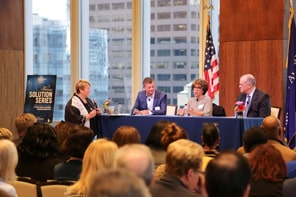
On Wednesday October 16th we hosted our biannual Solution Series — Organizational Structure: A Tool to Advance Innovation and Business Bottom Line—at Mutual of American in Manhattan.

A packed house of new and longtime supporters and friends of The Fedcap Group heard a dynamic panel of experts lead a compelling discussion about organizational structure. Hundreds more participated via livestream! The panel included – Michael Sicard, Chairman and CEO, USI Insurance Services Dianne Morales, Executive Director and CEO, Phipps Neighborhoods Mario Desideiro, Enterprise Solutions and Analytics Practice Leader, Managing Director, Huron Consulting Group Takeaways from the discussion were that structure should be designed to unlock teamwork and creativity; that structure must enable employees to always challenge themselves and have a vested interest in outcomes, and that structure must be flexible enough to allow for the ongoing infusion of new talent. The panel emphasized how strategy drives structure, that the design and building of structure must be intentional, and that while no single structure works for every organization, transparency and cross-functional teamwork are often hallmarks of successful structure.

Thanks to Mutual of America for hosting this event. Stay tuned for information about our spring Solution Series!

Like this article?

Share on Facebook
Share on Twitter
Share on Linkdin
Share on Pinterest
Leave a comment

Honoring our Veterans–Individually

Honoring our Veterans–Individually

As we honor our veterans today, I am so pleased to invite Colonel David Sutherland, Chairman of Dixon Center for Military and Veterans Services, to be my guest blogger. His experiences and voice are so important for us all to hear.

Diversity and inclusion frequently take a one-size-fits-all approach. For example, recruiting and retention may focus on veterans, as a whole, rather than the divergent qualities that enhance thinking and execution.

It’s ironic that lumping veterans together as a category defined as “diverse” may cause us to ignore the individual characteristics that make them assets to organizations.

I like to say that if you’ve met a veteran, you’ve met “a veteran.” One veteran, one time, each one is unique.

We veterans are more than just the sum of our parts. Yes, Veterans Day is a celebration of an amazing group of people. At the same time, we are remiss in not looking beyond the massed surface and into each one’s experiences and goals.

My wish is for you to get to know us as a unique group of people who have taken a different path to get to this point in our lives, and who may have hit roadblocks on this journey created by their service to our country. Let’s start with three areas key to ensuring that veterans succeed where they live:

Working with purpose. Those who served in uniform boast years of specialized training that make them experts in their fields, yet there remains significant underemployment and uncertainty. That’s why Dixon Center for Military and Veterans Services works with employers, hiring managers, and recruiters to improve workplace hiring programs. This work goes beyond employment programs for veterans as a whole and instead seeks to establish a culture that considers the specific skill sets of each veteran and matches them to the position best for them. Healing with honor. Let’s look at the data. Burn pits, enormous craters where waste is openly incinerated, are this generation’s Agent Orange. These chemical hazards are responsible for causing cancers, tumors and respiratory issues. Opioid abuse among combat-exposed individuals is 7 percentage points higher among those who deployed but didn’t see combat. Further, the number of veteran suicides exceeded 6,000 each year from 2008 – 2017 – or more than 60,000 over a decade. Part of what drives these numbers is an epidemic of disconnection that happens when we look at veterans en masse rather than creating a culture that considers the unique needs and isolation of each individual. It’s about making it personal – for both the veteran and the civilian.

Living with hope. T.S. Elliot said, “Home is where our story begins.” Dixon Center and its partners, among them Soldier On and Freddie Mac, are working to expand affordable housing, educate community-based organizations on fair housing practices for veterans, and increase compassionate outreach to those who are, or are at risk of becoming homeless. The goal is not to create new programs. Rather, the goal is to enable the integration of housing services that consider each veteran’s needs into existing programs to increase impact.

This Veterans Day let’s keep in mind that as with people, one size does not fit all. In fact, one size often fits none.

Like this article?

Share on Facebook
Share on Twitter
Share on Linkdin
Share on Pinterest

Leave a comment

Thought Leadership

Thought Leadership

In the age of social media, when anyone with many Friends or a large Twitter following can be considered a thought leader, we need to step back and consider exactly what thought leadership is in the non-profit world, and why it so important for us to develop it to our best advantage. Thought leadership is a way for a brand to position itself as a leader in its field or sector by demonstrating its values, its expertise, and sharing its thinking about the future.

Michael Brenner, recognized as a top marketing influencer by Forbes and by Huffington Post as a top business keynote speaker, believes “thought leadership means you provide the best and deepest answers to your customers’ biggest questions in the formats your audience likes to consume.” To Brenner “authentic thought leadership remains a driving force in successful companies across almost every industry.”

In Business News Daily, Skye Schooley, writing to define thought leadership and why it matters, adds “As a notable expert in a specific company, industry, or society, a thought leader is someone who offers guidance and insight to those around them. In other words, a thought leader has a positive reputation of helping others with their knowledge and insight.”

As Caroline Avakian points out in the Jewish Philanthropy blog: “Thought leadership is not just a PR function. It requires that we have an idea–something to make the world a better place, something that will solve a problem or improve a process.” Organizations can be treasure troves of excellent ideas waiting to be unleashed and shared with the world. These organizations can succeed with limited resources and small or non-existent communications and marketing teams that are allocated to drumming up support in an overcrowded charity marketplace.

An organization’s energy is sometimes focused on elevating a single member of its team to thought leadership status, usually someone high in the hierarchy like the executive director. At The Fedcap Group, conversely, we are totally committed to populating our organization with thought leaders who serve as a collective asset. When we foster a culture of deep learning and train staff in our core philosophy and values, we will develop more ways for thought leadership to become embedded in the DNA of the agency. We recognize that thought leadership can come from any source – executives, customers, product managers, designers, customer service reps, and sales people. We all have knowledge, experience and a point of view. As it permeates the organization, it organically spreads to the community.

Avakian notes, “Thought leadership is arguably the most effective and least expensive way an organization can build awareness, support for ideas, and influence the communities it needs to reach, including decision makers, policy makers and donors.”

Like this article?

Share on Facebook
Share on Twitter
Share on Linkdin
Share on Pinterest

Leave a comment

Finding The Best Talent In A Highly Competitive Environment

Finding The Best Talent In A Highly Competitive Environment

According to Roy Mauer in a blog for Society of HR Management, “Nonprofits should emulate corporate recruiting to compete for talent. Yet, 64% of nonprofits do not have a formal recruitment or retention strategy.”
Profit making companies can spend vast sums to bring top talent into their organizations, but what about organizations with limited funds that must compete for the same talent?
I believe it is our culture that drives people through our doors.
Jason Walker, Director of Talent Acquisition at Habitat for Humanity International, believes that a workplace culture that engages top talent requires a well-structured, strategic hiring plan closely tied to the agency’s mission. “In support of our mission,” he states, “we act intentionally to attract talent that has both the values and skills to expand Habitat’s impact and the way we address housing needs.’
The struggle is to know what you need and why you need it, then accept nothing less. This resonates with me. I have found that it is MUCH more costly and stressful to an organization to hire the wrong person because we are in a hurry to fill the slot, than it is to wait and find the right person.
Candance Ho from Whole Whale recommends that, after defining the talent required, an organization create a scorecard that lists all the attributes that it is looking for in an employee, and why those attributes are needed for that position. Whole Whale’s talent scorecard’s attributes include “efficiency, empathy, analytics, curiosity and a positive outlook.” At The Fedcap Group we use terms such as:
Passionate: They are driven to create/identify and resource the most effective ways to solve problems for people with barriers. Informed: They are current within their respective fields.
Credible: When they speak, people listen because of their depth of knowledge and expertise.
Smart and Fast: They can see the end result and take quick, thoughtful and decisive action.
Creative: They generate innovative and often unexpected answers to difficult problems. Curious: They thrive on new information and opportunities.
Dedicated: They run a continuous campaign to advance the position of The Fedcap Group and the people we serve.
Understand the concept of “Good to Great”: They constantly look for opportunities to improve the work of The Fedcap Group, searching for best-in-class practices, but not reinventing the wheel. Flexible: They are able and willing to do whatever it takes to get the job done. Fun: They take their work seriously, but not themselves.
Nonprofits also need to find candidates who care about their mission. Do they understand what we do? Can they describe it? Did they care enough to do the research?
Critical to finding the right candidate is having the right job description that makes people want to work for our organization. Recruitment at its core is marketing, and it is smart to engage a marketing firm to review the language in job descriptions. According to Nonprofit HR, the Corporate Leadership Council found that a well-executed EVP (employee value proposition) is invaluable in ensuring that job descriptions stand out. A good EVP is a simple, focused statement of why someone would want to work in your organization, and according to Nonprofit HR, it can improve the commitment of new hires by 29%. It can also solidify the organization’s brand and guide its recruitment strategy. “To create an EVP, compile data from employee engagement, onboarding and exit surveys. Identify key trends from among those three types of interactions. This may include information on benefits your employees value, elements of the workplace culture that help them succeed or simply why they enjoy working for the organization.”
We can compete with the for-profit environment—we must leverage our mission, have a smart strategy and tell the story of what we do in a compelling way.
I welcome your thoughts.

Like this article?

Share on Facebook
Share on Twitter
Share on Linkdin
Share on Pinterest

Leave a comment

Solution Series: Organizational Structure

Solution Series: Organizational Structure

On Wednesday October 16th we hosted our biannual Solution Series — Organizational Structure: A Tool to Advance Innovation and Business Bottom Line—at Mutual of American in Manhattan.

A packed house of new and longtime supporters and friends of The Fedcap Group heard a dynamic panel of experts lead a compelling discussion about organizational structure. Hundreds more participated via livestream! The panel included – Michael Sicard, Chairman and CEO, USI Insurance Services Dianne Morales, Executive Director and CEO, Phipps Neighborhoods Mario Desideiro, Enterprise Solutions and Analytics Practice Leader, Managing Director, Huron Consulting Group Takeaways from the discussion were that structure should be designed to unlock teamwork and creativity; that structure must enable employees to always challenge themselves and have a vested interest in outcomes, and that structure must be flexible enough to allow for the ongoing infusion of new talent. The panel emphasized how strategy drives structure, that the design and building of structure must be intentional, and that while no single structure works for every organization, transparency and cross-functional teamwork are often hallmarks of successful structure.

Thanks to Mutual of America for hosting this event. Stay tuned for information about our spring Solution Series!

Like this article?

Share on Facebook
Share on Twitter
Share on Linkdin
Share on Pinterest

Leave a comment

Sixth Annual Fedcap Golf Tournament

Sixth Annual Fedcap Golf Tournament

On Monday, August 12th The Fedcap Group held its annual Golf Tournament at Quaker Ridge Golf Club in Scarsdale, New York. Twenty-two golf foursomes played under beautiful summer skies at the highly regarded par-70 course designed by renowned golf course architect A. W. Tillinghast.

The event, attended by over 100 people, netted $60,000 to support young people who are transitioning from foster care and preparing for college and careers.  These extraordinary young men and women, at risk of homelessness and joblessness,  can now be provided with mentorship, high impact internships, and assistance in applying to and graduating from college.

Many thanks to our sponsors – Greenberg Traurig, Ken Raisler, IDB, Benefit Management Solutions Inc., People’s United Bank, Oracle, ABFS, American Paper and Supply, Sterling Sanitary Supply, SAS Maintenance, Platinum Maintenance, and Titanium Scaffold Services.  Thanks also to Quaker Ridge and all our friends and supporters who made this event possible.

Like this article?

Share on Facebook
Share on Twitter
Share on Linkdin
Share on Pinterest
Leave a comment

Solution Series: Socially Responsible Investing

Solution Series: Socially Responsible Investing

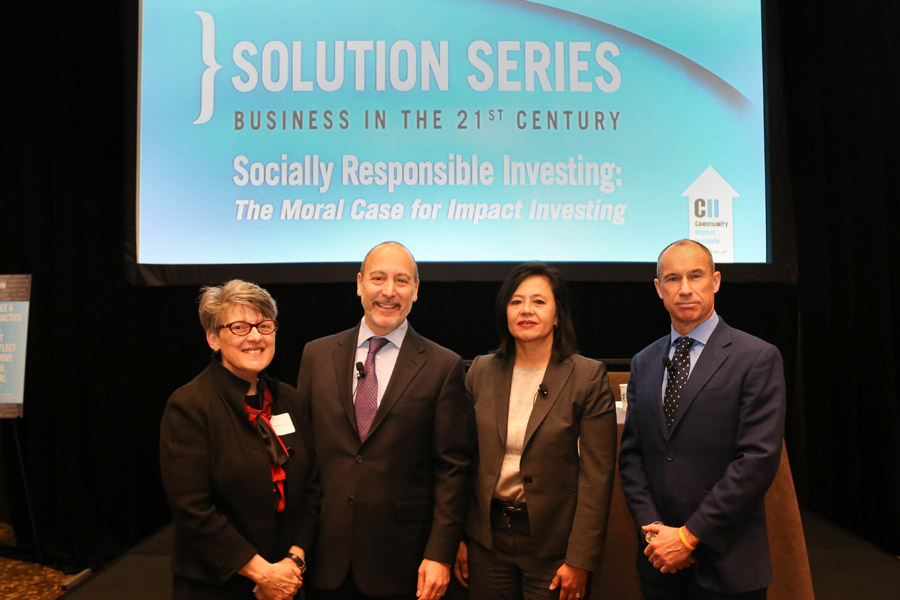
Socially responsible investing (SRI) targets the world’s most pressing challenges—scarce resources, climate change, poverty, human rights, diversity, and economic inequality. An astonishing $12 trillion–more than one out of every four dollars under management in the U.S. — is invested based on SRI strategies.

What is the responsibility of business? What motivates socially responsible investors? How is impact measured? A distinguished panel of experts addressed these and other key questions in a spirited and highly informative discussion at The Fedcap Group’s spring Solution Series on March 26th at The Westin New York Grand Central. The panel included:

• Christina L Alfandary, Managing Director ESG and Sustainable Investments, GAMCO Investors, Inc.

• Robert Brown, Senior Partner and Founder-Atlas Impact Partners

• Martin Whittaker, CEO, JUST Capital

A full house of business partners, supporters, board members and representatives of foundations, academia and NYC agencies attended the event.

Robert Brown provided an interesting history of SRI and a hopeful vision for its future, which will likely see more companies embracing impact investing principles as a core value and more rigorous frameworks for measuring impact. “Establishing and focusing on a set of SRI criteria is good for business and should just be part of what a company does. I would like to see more companies set and implement standards that reflect their values and move beyond aspirational statements to actual implementation,” he said.

Christina Alfandary, the author of a seminal paper about ESG, said that millennials are driving interest in impact investing because they see ESG issues as their own — if they don’t address challenges such as climate change it could be too late by the time their generation is in charge of government policy. More companies are recognizing that they need to be part of the solution, to embrace long-term thinking and a bottom line that includes both profits and impact.

“Social impact investing still has a long way to go to truly make a difference. What is needed is more cross-collaboration between the public and private sectors. Leveraging private capital markets is imperative to address these issues,” she said.

A fundamental question is how we define the social contract between markets and the society they serve. Martin Whittaker said that the vision articulated by economist Milton Friedman — that the only social responsibility of business was to increase its profits – doesn’t serve the needs of communities and is not good business. A growing number of companies recognize the vital role they can play in addressing society’s challenges and are the United Nations Sustainable Development Goals into their culture.

“I am optimistic. There is a growing number of investors demanding impact information, sustainability criteria, and the trends suggest we are moving in the right direction.”

Like this article?

Share on Facebook
Share on Twitter
Share on Linkdin
Share on Pinterest

Leave a comment

Fedcap Career Design School Graduation–a Moving Celebration of the Power of Possible!

Fedcap Career Design School Graduation–a Moving Celebration of the Power of Possible!

Wednesday, June 26th, marked a day of celebration as over 170 graduates of the Career Design School marched across the John Jay College stage to receive their certificates of achievement in Security, Home Health, Culinary Arts, Customer Service, Total Facilities Management, and Document Imaging/Office Administration. Cheered on by over 500 friends and family, the graduates celebrate new beginnings as they join the workforce and march toward economic well-being and security.

“It is one of my favorite days of the year,” said Christine McMahon, President and CEO of The Fedcap Group. “While our graduates are earning certificates in their chosen vocational areas, these certificates represent so much more. So many have overcome challenges to get to that stage. It is a thrill to honor the graduates’ achievements.”

Graduation featured speeches by three Career Design School participants, Devon Liburd, Jenny Medina, and Dominique Santos, who inspired their fellow graduates and the audience with stories of their journeys to the stage.

“It is so moving to see their joy and to see the graduates’ families and loved ones cheer them on,” said Donald Harreld, Senior Vice-president of the Education practice area. “They have many reasons to be proud of themselves, and we are so proud of them, too.”

Graduation is a pathway to sustainable employment and a better life–it is the Power of Possible in action.

Like this article?

Share on Facebook
Share on Twitter
Share on Linkdin
Share on Pinterest

Leave a comment